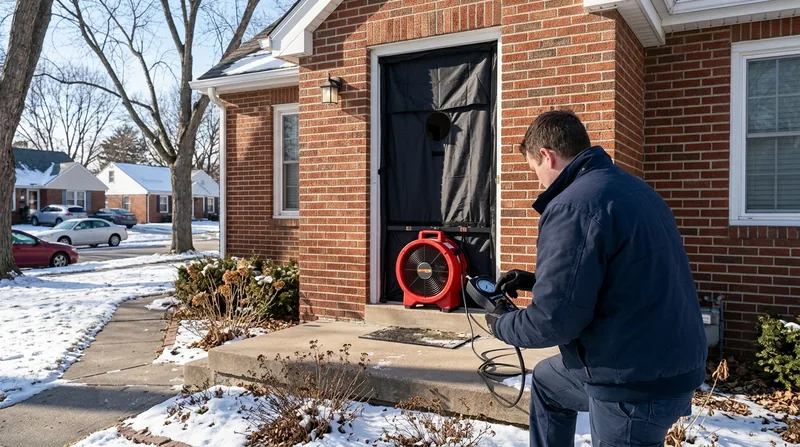




Stack effect in Des Moines homes pulls warm air up and out through the ceiling all winter, driving heating bills higher and leaving cold spots in bedrooms and living spaces. The air sealing work we do targets the exact leakage points that matter most: rim joists where the foundation meets the frame, top plates where walls meet the attic, and penetrations for pipes, wires, and HVAC lines. In IECC climate zone 5A, where Iowa winters are long and unforgiving, these gaps cost real money month after month. Whether your home is a brick bungalow in Beaverdale built in the 1930s, a postwar ranch in Pleasant Hill, or a newer two-story in West Des Moines or Ankeny, the stack effect works the same way. We seal those leaks with spray foam and caulk to cut drafts, lower your ACH50 readings, and keep conditioned air inside where it belongs.
Why Air Sealing Matters in Cold-Climate Des Moines Homes
Des Moines sits over basement foundations and sits under vented attics that bleed heat in winter and let hot air soak in during summer. The rim joist is the coldest, leakiest band in the house, running the full perimeter where the basement rim meets the first floor frame. Top plates at the attic are the second major leak path, especially in older homes with no air barrier and in newer builder-grade construction where penetrations are left unsealed. Mechanical penetrations for supply and return ducts, wiring, and plumbing stacks are third. When you heat a home in Des Moines, warm air naturally rises through these gaps and escapes into the attic, pulling cold air in from the basement and crawl space below. That is stack effect, and it is why your heating bill climbs and why you have cold bedrooms over the garage.
- Sealing rim and band joists stops heat loss at the foundation and cuts basement cold drafts into living space.
- Sealing top plates and attic penetrations closes the upper escape route and reduces the pressure that drives stack effect.
- Sealing mechanical penetrations around ducts, pipes, and wires prevents conditioned air from leaking directly into unconditioned space.
- Lower air leakage (measured as ACH50) means your furnace and air conditioner run less often and your bills drop.
Air sealing is the foundation of energy efficiency in a Des Moines home, and it pays for itself faster than adding insulation alone because it stops the flow that makes insulation work harder.
Key insight: A typical Des Moines home built before 1980 has rim joist leakage that alone can account for 10 to 15 percent of winter heating loss. Sealing the rim joist is often the single highest-return air sealing job we do, especially in Sherman Hill, Beaverdale, and the historic neighborhoods where homes sit over exposed basements and crawl spaces.
For more on how spray foam insulation ties into the larger energy picture, see our attic spray foam insulation service, which pairs air sealing with R-value to create a complete thermal envelope.
For permit and code questions specific to your address in Des Moines, check the City of Des Moines Planning and Zoning Department or your local building official, as energy code and thermal barrier rules vary by city across Polk County.
How We Air Seal Des Moines Homes: The Step-by-Step Process
Air sealing is not one technique but a sequence of inspections, diagnosis, and targeted applications. We start by identifying where air is actually leaking, using visual inspection and sometimes blower door testing to pinpoint the biggest gaps. Then we choose the right material for each gap: spray foam for larger voids (rim joists, top plates, band joists), caulk or backer rod for smaller cracks and seams, and foam board or rigid seal for mechanical penetrations. Each step is done before insulation is added, because sealing the leak path is the job, and insulation fills the cavity once the air barrier is set.
- We inspect the rim joist, top plate, attic penetrations, and mechanical chases to locate air leakage paths.
- We prepare the substrate: clean, dry surfaces so that foam and caulk adhere properly and seal correctly.
- We seal rim and band joists with closed-cell spray foam, which also adds R-value and stops moisture.
- We seal top plates, attic rim, and penetrations with spray foam or caulk, depending on gap size and access.
- We seal mechanical penetrations around ducts, pipes, and wiring with foam, caulk, or gaskets so air cannot bypass them.
- We test the work and document R-value and thickness per specification so you have a record of what was done.
The result is a continuous air barrier that stops stack effect and lets your heating and cooling system work efficiently.
Real example: A 1960s split-level in Johnston had cold bedrooms on the second floor and a drafty basement. We sealed the rim joist around the entire foundation perimeter with closed-cell foam, sealed the top plate where the exterior walls met the attic, and sealed the mechanical chases for the return air ductwork. After sealing, the homeowner reported warmer bedrooms and a noticeably quieter furnace. No insulation was added because the existing batts were adequate once the air leaks were closed.
For more on the foam products we use in air sealing work, see our pages on closed-cell spray foam and open-cell spray foam.
Air Sealing Methods and Materials for Des Moines
| Approach | Description | Best for |
|---|---|---|
| Closed-Cell Spray Foam | Two-part polyurethane foam, 1.5 to 2 lbs/cu.ft. density, sprayed and cured to form a rigid, air-tight seal with high R-value per inch. | Rim and band joists, rim board at attic, mechanical chases, areas where moisture control and structural support matter. |
| Open-Cell Spray Foam | Two-part polyurethane foam, 0.5 lbs/cu.ft. density, sprayed to form a semi-rigid, permeable air seal with moderate R-value and sound dampening. | Interior wall cavities, attic rim and top plates where vapor permeability is acceptable, garage ceilings, sound control. |
| Caulk and Sealant | Polyurethane or silicone caulk applied to cracks, seams, and small gaps where spray foam is overkill or access is tight. | Cracks in rim board, seams in top plate, gaps around wiring and plumbing penetrations, window and door rough openings. |
| Foam Board and Rigid Seal | Rigid foam board cut and fitted to seal large voids, plus foam or gasket tape for mechanical and electrical penetrations. | Large gaps at mechanical chases, rim joist blocking, band joist blocking, areas where spray foam application is not practical. |
Each method is chosen based on the gap size, the substrate, moisture exposure, and access. The goal is always the same: stop air movement and create a continuous air barrier so stack effect cannot pull conditioned air into unconditioned space.
Air Sealing Cost in Des Moines: What to Expect
Air sealing costs in Des Moines depend on the scope of work, the materials used, and the size and complexity of the home. Rim joist sealing is typically the largest component because the rim runs the full perimeter of the foundation. A modest 1,500 square foot ranch with a straightforward rim joist and no attic access issues may start around $650 to $1,200. A larger 2,500 square foot two-story with a complex attic layout, multiple mechanical chases, and crawl space rim work will be higher. Jobs that also include insulation removal or replacement of failed foam add labor and disposal cost.
Factors that affect the final price include the linear feet of rim joist to seal, the height and accessibility of the attic, the number of mechanical penetrations, whether existing insulation must be removed first, and the type of foam or sealant chosen. Closed-cell foam costs more per board foot than open-cell but adds R-value and moisture resistance, which is critical at rim joists in Iowa's humid summers and cold winters. A free estimate from our crew includes a detailed walkthrough, a measurement of the work area, and a written quote with R-value and thickness specifications so you know exactly what you are paying for.
For a detailed pricing overview and to request a free estimate, visit our pricing page or call us at (515) 633-1026. We respond within 24 hours and there is no obligation to book.
What to Look for When Hiring an Air Sealing Contractor Near Des Moines
Air sealing is technical work that requires proper equipment, material knowledge, and attention to detail. When you are evaluating contractors near you in Des Moines, Ankeny, West Des Moines, or anywhere in Polk County, there are several red flags and green flags to watch for. Get at least two or three estimates so you can compare scope, materials, and price. A professional estimate should include measurements, a description of the materials to be used, the R-value and thickness of any foam, and a timeline. If a contractor gives you a price without specifying R-value or thickness, or without visiting the site, move on. Ask for references from recent air sealing jobs in Des Moines and call them. Verify that the contractor carries full insurance and ask to see the certificate of insurance naming you as an additional insured. Ask about the re-entry window after spray foam application (typically 24 to 48 hours) and whether mechanical ventilation is used during cure, because proper ventilation is a sign of a professional shop.
- Request a written estimate with R-value, thickness, and material specifications so you know what you are paying for.
- Ask whether the contractor will visit your home in person and inspect the rim joist, attic, and mechanical chases before quoting.
- Verify full insurance coverage and ask for a certificate of insurance before work begins.
- Check references from recent air sealing jobs in Des Moines, West Des Moines, Urbandale, or Johnston to confirm quality and professionalism.
- Confirm that mechanical ventilation is used during spray foam application and that a re-entry window of 24 to 48 hours is observed.
- Ask about permits and whether the contractor will help you navigate local code and building department requirements for your address.
A local contractor with a Des Moines address, local plates, and a track record of work in your neighborhood is your best bet. For a free estimate and a walk-through of your home, contact us today.
Air Sealing in Des Moines: Pricing Guide
| Service | Price | Details |
|---|---|---|
| Rim Joist Sealing | Starting at $650 | Closed-cell spray foam seal of rim board perimeter, includes substrate prep and written R-value specification, varies by foundation linear footage |
| Top Plate and Attic Rim Sealing | Starting at $450 | Spray foam seal of top plate perimeter and attic rim board, includes mechanical penetrations, cost scales with attic square footage and complexity |
| Mechanical Penetration Sealing | Starting at $300 | Foam and caulk seal of HVAC ducts, plumbing, electrical chases, and other building penetrations, priced per location or as part of larger air sealing scope |
| Full Home Air Sealing Package | On estimate | Rim joist plus top plate plus mechanical penetrations plus any attic or crawl space sealing, requires site inspection for accurate scope and pricing |
| Travel | Included | No additional charge for service calls within Des Moines and surrounding Polk County cities, included in all quoted work |
| Free Estimate | Free | Site visit, measurement, written quote with specifications, no obligation to book, response within 24 hours at (515) 633-1026 |
Indicative pricing, the exact cost depends on square footage, finish, and site access. Free personalized estimate within 24h at (515) 633-1026.


