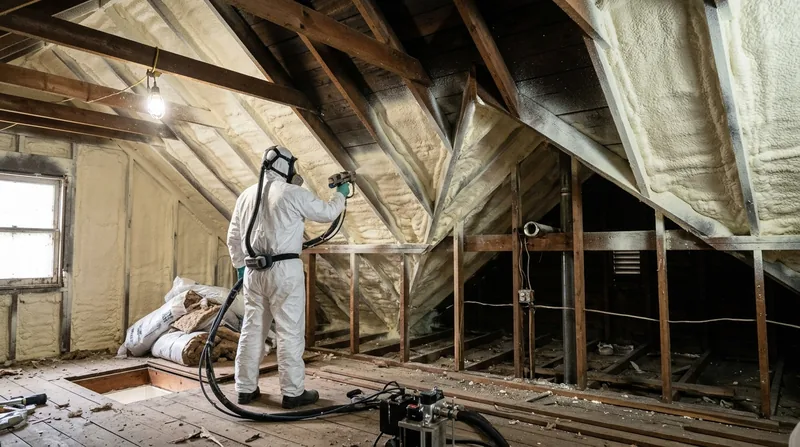




Homes around Drake and Highland Park, and across the early neighborhoods of Des Moines, often carry insulation that has settled, failed, or been damaged by moisture and time. Insulation Replacement & Re-Insulation in Des Moines means removing old material, addressing air leaks, and installing new spray foam or blown-in insulation suited to zone 5A's hard winters and humid summers. Iowa's climate pulls warm air up and out of attics in winter and lets heat bake into upstairs rooms in summer, both driven by the same gaps that builder-grade batts and settled fiberglass leave behind. We clear out the old, seal the leaks, and install new insulation that closes those gaps for good. This page explains why replacement matters in Des Moines, how we do it, what it costs, and how to choose the right contractor for your home.
Why Insulation Replacement Matters in Des Moines: The Cost of Waiting
Old insulation fails for three reasons: settling, moisture damage, and air gaps left by original installation. A home built in the 1950s or 1960s with fiberglass batts now has material that has compressed by 20 to 40 percent, losing R-value as it sags. Homes in Beaverdale, Sherman Hill, and around Highland Park often show water stains in attics or damp rim joists, signs that vapor is moving through the insulation instead of being blocked. Even newer builder-grade insulation leaves gaps at top plates, around penetrations, and where walls meet the attic, all of which let stack effect pull warm air out in winter and hot air in during summer.
- Settled fiberglass loses R-value and no longer blocks air movement, forcing your heating and cooling to work harder every season.
- Water-damaged insulation holds moisture and loses its ability to insulate, and may support mold growth if the source is not fixed first.
- Gaps around electrical boxes, HVAC penetrations, and rim joists let unconditioned air bypass the insulation entirely, creating cold spots and high bills.
- Old blown-in insulation compresses unevenly, leaving some areas thin and others thick, with no consistent R-value across the space.
Replacing insulation stops these losses and restores the thermal envelope that keeps your home comfortable and your energy bills reasonable through an Iowa winter.
Key info: Homes in Des Moines sit in IECC zone 5A, where stack effect is the dominant failure mode. Warm air rises and escapes through the ceiling in winter, pulling cold air in through basement rim joists and lower walls. Replacing insulation without sealing the rim joist and attic air gaps leaves the job half done. We address both.
For more on the air sealing that complements insulation replacement, see our air sealing service page.
How We Replace Insulation in Des Moines: Process and Methods
Insulation replacement starts with removal and assessment. We pull out old material, inspect the framing for moisture or damage, and check that the substrate is dry and sound. If moisture is present, we identify the source and defer the spray foam job until it is fixed. Once the space is clear and dry, we measure the area, calculate R-value and thickness needed for zone 5A, and choose the right product for the job. Open cell foam is lighter and cheaper, suited to attics where moisture can move freely. Closed cell foam is denser and carries higher R-value, essential for rim joists, basements, and walls where vapor control matters.
- We remove old insulation, haul it off site, and dispose of it responsibly, leaving the space ready for new material.
- We inspect framing and substrate for moisture, rot, or pest damage before any new insulation is installed.
- We seal air gaps around penetrations, rim joists, and top plates with spray foam before topping off the attic with blown-in insulation or additional foam.
- We install new spray foam at the correct thickness per pass, with proper drum temperature and ratio, and provide mechanical ventilation during cure.
- We specify the R-value and thickness in writing on your estimate, so you know exactly what you are getting.
The result is an insulation system that seals air leaks, stops moisture movement, and restores the R-value your home needs to handle Des Moines winters without burning energy.
Example: A 1960s ranch in West Des Moines with settled fiberglass in the attic and cold bedrooms over an attached garage. We remove the old insulation, seal the rim joist and top plates with closed cell foam, then install open cell spray foam in the attic to R-38. The homeowner sees warmer bedrooms, lower bills, and no cold spots by the first hard freeze. See our attic spray foam insulation page for more on this signature application.
Insulation Replacement Methods and When to Use Them
| Approach | Description | Best for |
|---|---|---|
| Open Cell Spray Foam | Light, semi-rigid foam that expands to fill gaps and allows vapor to move, cures in 24 hours, costs less than closed cell. | Attics in dry climates or where moisture is not a concern, sound dampening, and homes where cost is the primary driver. |
| Closed Cell Spray Foam | Dense, rigid foam with high R-value per inch, blocks vapor movement, creates a vapor barrier, and adds structural strength. | Rim joists, basement walls, crawl spaces, metal buildings, and any application where moisture control or R-value per inch is critical. |
| Blown-In Cellulose or Fiberglass | Loose-fill material pneumatically installed to a target density and R-value, lowest cost, suits attics with even framing and no air leak focus. | Top-up of existing attics where air sealing is not the priority, or where budget limits the scope to insulation only. |
| Hybrid: Spray Foam Air Sealing Plus Blown-In | Seal gaps and penetrations with spray foam, then blow in cellulose or fiberglass to reach target R-value, balances cost and performance. | Most attic replacements in Des Moines, where air leaks are the first problem and total R-value is the second. |
Insulation Replacement & Re-Insulation Cost in Des Moines: What to Expect
Insulation replacement cost depends on the size of the space, the type of insulation chosen, whether air sealing is included, and whether the old material is heavily contaminated or hard to access. A typical attic replacement in a 1,500-square-foot ranch or split-level home in Des Moines or West Des Moines runs from $2,800 to $5,500, with the range reflecting the choice between open cell and closed cell, and the amount of air sealing work needed. Rim joist and crawl space work, which requires closed cell foam and precise application, typically runs higher per square foot. A free, on-site estimate is the only honest way to price the job, because spray foam is measured at the board foot and the R-value specification depends on the existing condition and your goals.
- Attic insulation replacement with air sealing and open cell foam typically starts at $2,800 for smaller homes or top-up work.
- Rim joist and basement band replacement with closed cell foam runs higher due to material cost and the precision required.
- Crawl space insulation replacement, including substrate prep and closed cell application, is priced on site because access and contamination vary widely.
- Wall cavity injection foam retrofit is priced per linear foot of wall and per cavity, with costs driven by the number of holes and the depth of the wall.
Get two or three estimates from local contractors so you can compare scope, R-value, and price. See our pricing page for more detail on what moves the cost up or down, and call us at (515) 633-1026 for a free estimate with no obligation.
Insulation Replacement & Re-Insulation Near Me: What Des Moines Homeowners Should Know When Hiring
Choosing a spray foam contractor is not just about price. The trade includes rig-and-run crews that spray a job in an afternoon, hand you a bill, and disappear when the smell will not go away. It also includes national franchises with high overhead and limited local knowledge. A local, independent contractor with a local address, local plates, and a track record in Des Moines is your strongest position. Before you hire, verify that the contractor carries full insurance, ask to see a certificate, and understand what coverage applies to your job. Ask for an estimate that names the R-value and thickness of the insulation being installed, not just a price per board foot. Check references from homes in Des Moines or nearby towns, and ask those homeowners about the cure process, re-entry timing, and how the contractor handled any issues after the job.
- Verify that the contractor is fully insured and ask to see a current certificate of insurance before work begins.
- Get a written estimate that specifies R-value, thickness, and the type of foam or blown-in material being used.
- Ask whether the contractor will provide mechanical ventilation during cure and what re-entry window they recommend.
- Check with the Des Moines Building Department to understand what permits apply to your address and whether the contractor will help you navigate the process.
- Call references from previous jobs in Des Moines, Ankeny, West Des Moines, or nearby areas to learn about the contractor's work quality and responsiveness after the job.
- If your home is in a master-planned community or HOA, check whether architectural rules govern exterior work or equipment placement during the job.
For a free estimate and to discuss your specific home and insulation needs, contact us at (515) 633-1026 or visit our contact page. We have served Des Moines and the surrounding area since 2015, and we are ready to walk through your project and answer your questions.
Insulation Replacement & Re-Insulation in Des Moines: Pricing Guide
| Service | Price | Details |
|---|---|---|
| Attic insulation replacement with air sealing | Starting at $2,800 | Includes removal of old insulation, sealing air leaks at rim joist and penetrations, and blown-in or open cell foam to R-38 or higher |
| Rim joist and basement band replacement | Starting at $1,200 | Closed cell spray foam application to rim joists and band joists, typical for a 30-foot perimeter with 12-inch depth coverage |
| Crawl space insulation replacement | On estimate | Cost depends on crawl space size, access, moisture condition, and whether substrate prep or drainage work is needed before foam application |
| Wall cavity injection foam retrofit | Starting at $800 | Priced per linear foot of wall cavity filled, typical range for a single-wall retrofit in a 1,000-square-foot home or addition |
| Travel and estimate | Free | No mileage fee or travel charge in Des Moines and surrounding service areas, estimate response within 24 hours at (515) 633-1026 |
Indicative pricing, the exact cost depends on square footage, finish, and site access. Free personalized estimate within 24h at (515) 633-1026.


