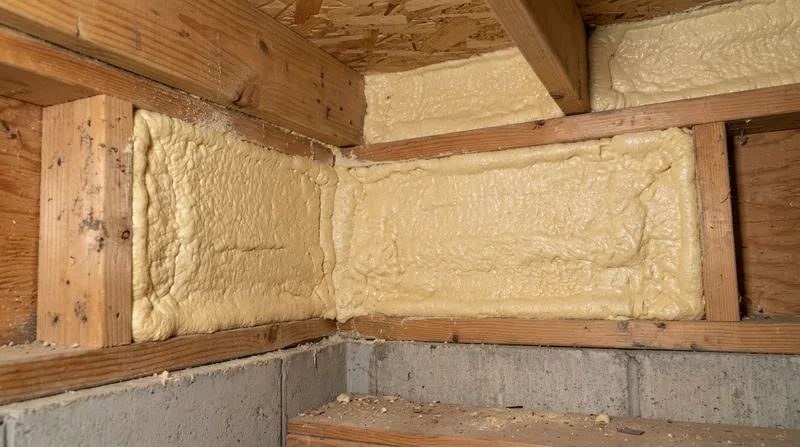




Closed cell spray foam insulation in Des Moines is the dense, high-performance answer to the specific moisture and thermal challenges of zone 5A winters and humid summers across Polk County. Des Moines sits in the path of hard freezes that drive stack effect up through attics and basement rim joists, while summer humidity pushes moisture inward through walls. Closed cell foam stops both: it delivers 6+ R-value per inch, resists vapor transmission, and holds up in the rim joists and basement walls that take the worst of an Iowa winter. Whether you own a 1920s brick home in Beaverdale, a postwar ranch in Pleasant Hill, or a new build in Ankeny or Waukee, closed cell foam addresses the leakage and condensation that fiberglass and open cell cannot. We have been installing spray foam insulation across Des Moines and the surrounding metro since 2015, and closed cell is the workhorse of our work in basements, new construction, and retrofit walls where density and R-value per inch matter most.
Why Closed Cell Spray Foam Matters in Des Moines' Cold, Humid Climate
Des Moines winters are relentless, and the stack effect that dominates heating season pulls warm air upward and out through rim joists, basement band joists, and ceiling leaks. Humidity in summer pushes inward through walls and attics. Fiberglass does not stop air leakage, and open cell foam is too permeable to stand up to that vapor pressure. Closed cell foam seals air, resists moisture, and delivers the R-value per inch that matters when space is tight or when the thermal envelope is the difference between a cold basement and a livable one.
- Closed cell foam achieves 6+ R-value per inch, so you get more thermal resistance in less thickness than open cell or fiberglass.
- At full thickness it acts as a vapor retarder, slowing moisture movement through walls and keeping condensation off cold rim joists in winter.
- It bonds to concrete, steel, and wood, making it the right choice for rim joists, basement walls, and metal building skins where air sealing and adhesion both matter.
- It handles the humidity swings of Des Moines summers without absorbing water or losing performance, a critical advantage over open cell in basement and crawl space walls.
In older Des Moines neighborhoods like Sherman Hill and Highland Park, where 1900s and 1920s brick homes still carry uninsulated rim joists and vented attics, closed cell foam in the rim and basement band joist is often the single biggest upgrade a homeowner can make. New construction across Urbandale, Johnston, and Waukee benefits just as much: builders who seal rim joists and band joists with closed cell before drywall goes up eliminate the cold bedroom over the garage and the basement moisture that plagues builder-grade framing.
Key info: Des Moines is in IECC zone 5A, where the heating season is long and cold, and summer humidity is high. Closed cell foam's vapor resistance makes it the correct choice for rim joists, basement walls, and sealed attics where moisture control is as important as thermal resistance. Open cell foam is permeable and is the wrong product for these applications.
For guidance on permits and thermal barriers in your Des Moines neighborhood, check with your local building department or visit the rim joist and band joist spray foam page to understand how this application works in practice.
How We Install Closed Cell Spray Foam in Des Moines Homes and Buildings
Closed cell foam installation is a controlled process: we prep the substrate, seal any active leaks, set up mechanical ventilation, spray the foam in thin passes to the specified thickness, and hold a re-entry window of 24 to 48 hours before the space is occupied. The foam expands as it cures, bonds to the surface, and reaches full strength in 24 hours. Every job starts with a written estimate that specifies R-value, thickness in inches, and board feet, so you know exactly what you are paying for and what the finished assembly will perform at.
- We inspect the substrate for moisture, active leaks, or contamination, and we do not spray over a wet or compromised surface.
- We set up temporary mechanical ventilation to manage VOC off-gassing during and after the spray, and we provide a clear re-entry window before you occupy the space.
- We spray closed cell foam in thin passes (typically 1 to 1.5 inches per pass) to control density, ensure proper expansion, and avoid over-packing that can trap moisture or create weak spots.
- We verify thickness and coverage with a depth gauge and visual inspection, and we document the job with a completion report that includes R-value and board-foot totals.
A typical rim joist application in a Des Moines basement takes one to two hours per 100 linear feet, depending on access and surface prep. A sealed attic retrofit in a 1,500-square-foot ranch or split-level typically takes a full day. New construction spray-in-place walls on a two-story frame house in Clive or Ankeny are scheduled around the framing phase, before drywall or sheathing closes the cavity.
Example: A homeowner in Beaverdale with a 1930s brick home, an uninsulated rim joist, and cold basement walls calls for a closed cell retrofit. We prep the rim and band joist, spray 2 inches of closed cell foam (R-12 to R-13), and seal all air leaks around rim penetrations. The job takes 4 to 6 hours. The homeowner sets up mechanical ventilation, waits 24 hours, and the basement is noticeably warmer and drier by the next heating season.
For details on how closed cell foam fits into a larger attic or wall retrofit, see our page on attic spray foam insulation in Des Moines or wall and injection foam insulation to understand how these applications integrate with other air sealing and insulation strategies.
Closed Cell Spray Foam Installation Methods and Applications
| Application | Approach | Best for Des Moines |
|---|---|---|
| Rim and Band Joist | Spray 2 to 3 inches of closed cell foam directly onto the rim joist, band joist, and rim penetrations from inside the basement. Covers the entire perimeter and seals all air leakage at the rim. | Homes in Beaverdale, Sherman Hill, and older neighborhoods with uninsulated or poorly insulated rim joists. Single biggest thermal and moisture upgrade for a basement. |
| Basement Walls | Spray 2 to 4 inches of closed cell foam directly onto interior concrete or block basement walls. Creates a continuous vapor barrier and thermal break between the conditioned space and the cold earth. | Basements with active moisture, high humidity, or cold wall surfaces. Finished basements in Ankeny, Urbandale, and Johnston where comfort and mold prevention are priorities. |
| Sealed Attic Deck | Spray 5 to 7 inches of closed cell foam on the underside of the roof deck and seal all penetrations, creating a conditioned attic that is part of the thermal envelope. No soffit vents required. | New construction and retrofits in Clive, Waukee, and West Des Moines where attic space will be conditioned. Eliminates hot upstairs rooms in summer and cold attics in winter. |
| Wall Cavity Retrofit | Drill small holes in exterior sheathing or interior drywall, inject closed cell foam into wall cavities, and seal the holes. No demolition required. Fills gaps and stops air leakage in existing walls. | Pre-1980 homes across Des Moines with empty or partially filled wall cavities. Common in bungalows around Drake and Highland Park where walls were never insulated. |
| Metal Building and Pole Barn | Spray closed cell foam directly onto the interior of metal roof and wall panels. Creates a thermal break and vapor barrier that prevents condensation on cold steel. | Barndominiums, agricultural buildings, and metal-framed commercial shells in rural Polk and Dallas counties. Closed cell is the only foam that stops condensation on metal skins. |
Closed Cell Spray Foam Insulation Cost in Des Moines: What to Expect
Closed cell spray foam costs more per board foot than open cell or blown-in fiberglass, but it delivers higher R-value per inch and solves moisture problems that cheaper insulation cannot. In Des Moines, closed cell foam typically runs from $1.20 to $2.00 per board foot installed, depending on job size, substrate prep, access, and whether removal of old insulation is required. A rim joist retrofit of 100 linear feet at 2 inches thick runs 200 to 300 board feet and costs $240 to $600. A sealed attic on a 1,500-square-foot ranch at 6 inches thick runs 750 to 1,000 board feet and costs $900 to $2,000. Basement wall insulation on 500 square feet at 3 inches runs 150 to 200 board feet and costs $180 to $400.
Several factors move the price within that range. Substrate condition matters: if we have to remove old insulation, patch holes, or repair moisture damage before we spray, the job costs more. Thickness and R-value are specified in your estimate: 2 inches costs less than 4 inches, but 4 inches delivers R-24 instead of R-12, and the difference is often worth the cost in a basement or sealed attic. Access and geometry affect labor: a simple rim joist in an open basement takes less time than a tight crawl space or a roof deck with many penetrations. Size matters too: a 50-board-foot job costs more per board foot than a 500-board-foot job because setup and travel are the same either way.
Getting two or three written estimates is the smart move. Each should specify R-value, thickness in inches, square footage or board feet, and the total price. If an estimate has no R-value and no thickness, it is not an estimate, it is a guess. If the price is far below market with no inspection and no detail, it is a red flag: closed cell foam requires equipment, training, and ventilation, and a price that is too low usually means shortcuts in the spray, the cure, or the inspection.
For a detailed breakdown of pricing across all our services, including rim joist, basement, attic, and wall applications, see our full pricing page.
Closed Cell Spray Foam Insulation Near Me: What to Look for When Hiring a Contractor in Des Moines
Hiring the right spray foam contractor matters more than price. The trade includes local independents, national franchises, and rig-and-run crews that spray a job in an afternoon and disappear. A good contractor is fully insured, provides written estimates with R-value and thickness, sets up mechanical ventilation during cure, and stands behind the work with a clear warranty on labor. You should be able to call them after the job is done and reach someone who can answer questions about the smell, the cure time, or the re-entry window.
- Verify that the contractor is fully insured and can provide a certificate of insurance before work begins.
- Get a written estimate that specifies R-value, thickness in inches, board feet or square footage, and the total price, with no surprises added later.
- Ask for references from jobs done in Des Moines, Ankeny, West Des Moines, or Johnston in the past year, and call at least two to ask about the quality of the work and the contractor's responsiveness after the job.
- Understand what permits apply at your address: attic ventilation, ignition barriers, and thermal barriers are governed by code, and your local building department in Des Moines, Urbandale, or Clive has the final say, not the contractor.
- If you have an HOA, check whether exterior work or metal building insulation requires architectural approval before you schedule the job.
If you are ready to move forward, call us at (515) 633-1026 or contact us for a free estimate. We will schedule a site visit, walk through the scope, and give you a detailed written estimate with no obligation to book. We have been installing spray foam across Des Moines and the metro for over eight years, and we are here to answer your questions and help you understand what closed cell foam can do for your home or building.
Closed Cell Spray Foam Insulation in Des Moines: Pricing Guide
| Service | Price | Details |
|---|---|---|
| Rim Joist and Band Joist | Starting at $1.50/board ft | Typical retrofit of 200-300 board feet costs $300-450, depending on linear footage and substrate prep |
| Basement Walls | Starting at $1.40/board ft | Interior concrete or block walls, 3 inches thick, cost $210-280 per 100 square feet, plus moisture remediation if needed |
| Sealed Attic Deck | Starting at $1.20/board ft | 5-7 inches thick on roof deck, typical 1,500 sq ft ranch runs 750-1,000 board feet, cost $900-1,200 plus removal if old insulation present |
| Wall Cavity Injection | Starting at $1.60/board ft | Retrofit of existing walls without demolition, 100 square feet runs 50-75 board feet, cost $80-120 plus drilling and patching |
| Metal Building or Pole Barn | On estimate | Spray-in-place on interior metal skins, cost depends on square footage, height, and roof pitch; full inspection required |
| Estimate and Travel | Free | Response within 24 hours at (515) 633-1026, no obligation, includes written estimate with R-value and thickness |
Indicative pricing, the exact cost depends on square footage, finish, and site access. Free personalized estimate within 24h at (515) 633-1026.


