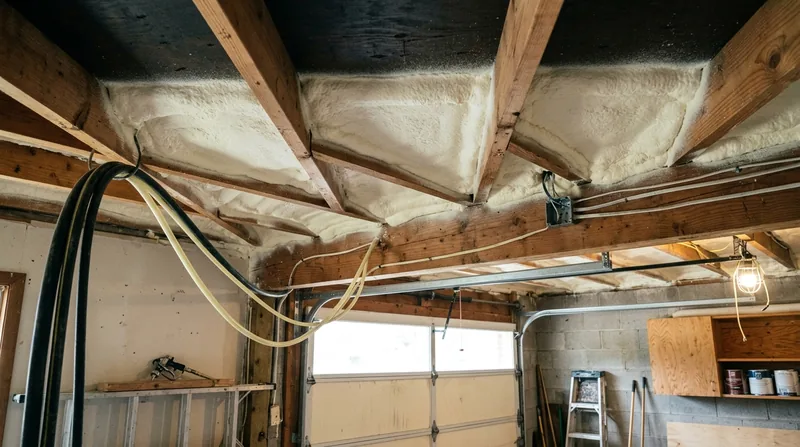




Cold bedrooms over attached garages are a fact of life across postwar Polk County ranches and split-levels, especially when an Iowa winter settles in. Stack effect pulls warm air up through the ceiling during heating season, and an uninsulated or poorly insulated garage ceiling becomes a thermal bridge that drains heat from the room above. Garage spray foam insulation in Des Moines seals the gap between your living space and the unheated garage below, blocking cold air infiltration before it reaches your bedroom or family room. In a climate zone 5A winter, this is not cosmetic work. A single unfoamed garage ceiling shared with a finished room above can cost you hundreds of dollars in wasted heat over a season. We foam the garage ceiling and shared walls to block cold air before it reaches the room above, and we do it with the precision that turns a complaint into solved problem.
Why Garage Ceiling Insulation Matters in Des Moines
Des Moines sits in a climate where the temperature difference between your heated home and an unheated garage can reach 40 degrees or more on a winter night. That temperature gradient drives heat loss through the shared wall and ceiling at a rate that standard fiberglass batts cannot stop. Attached garages are standard on postwar ranches from Beaverdale to West Des Moines, and nearly every one has a cold bedroom directly above it. The problem shows up as a room that stays 5 to 15 degrees colder than the rest of the house, a thermostat that runs harder to compensate, and heating bills that climb every winter.
- Spray foam seals air leaks at the rim joist and band board where the garage wall meets the foundation, stopping the stack effect at its source.
- Closed cell foam on the garage ceiling creates an air barrier that blocks cold from rising into the room above, even in subzero cold.
- Open cell foam in the garage walls dampens sound transmission from the garage to living space, a secondary benefit many homeowners notice immediately.
- Proper foam thickness and coverage eliminates the thermal short circuits that fiberglass batts leave behind at rim joists and band joists.
The result is a bedroom that stays warm without extra thermostat tweaks, and energy bills that reflect actual insulation, not wasted heat flowing downward.
Key info: A Beaverdale ranch with a cold master bedroom over an attached garage saw a 12-degree temperature difference between that room and the rest of the house during winter. After garage ceiling and shared wall foam, the room stayed within 2 degrees of the rest of the house, and the homeowner cut heating costs by roughly 18 percent over the following winter.
For detailed information on how spray foam insulation works across your entire home, see our attic spray foam insulation service, which addresses the same stack effect problem at the top of the house.
How We Insulate Garage Ceilings and Shared Walls in Des Moines
Garage spray foam work starts with understanding what you have. If the garage ceiling is open (exposed joists), we spray closed cell foam directly onto the underside of the rim joist and band board, then across the ceiling deck. If the garage has a finished ceiling, we drill access holes in the rim joist and band area and inject foam into the wall cavity, which stops cold air at the boundary between the garage and the floor system above. Shared walls between the garage and finished space get the same treatment: we identify rim and band joists, any rim joist gaps, and penetrations for electrical boxes or ductwork, then seal and insulate in one pass.
- We inspect the garage ceiling and shared walls for existing insulation, moisture, or damage before we spray anything.
- We set up mechanical ventilation in the garage during foam application and cure to manage fumes and ensure safe re-entry within 24 to 48 hours.
- We spray closed cell foam at the proper ratio and drum temperature, controlling thickness per pass to meet code R-value and prevent voids or fisheyes.
- We identify and seal rim joist and band joist areas first, because that is where cold air enters the floor system in a Polk County winter.
- We trim excess foam and install any required thermal barriers or ignition barriers per Des Moines building code before you re-enter the space.
The entire process takes one to two days depending on garage size and whether the ceiling is open or finished. You can use the garage again within 24 to 48 hours of completion.
Example: A Johnston split-level had a finished garage with drywall ceiling. We drilled access holes in the rim joist and band board, injected closed cell foam into the cavity, and sealed the shared wall where it met the bedroom. The job took one day, and the homeowner reported a noticeably warmer bedroom within one week.
For more on how we handle walls and injection foam, see our wall and injection foam insulation service.
Garage Foam Methods: Open Ceiling vs. Finished Ceiling
| Approach | Description | Best For |
|---|---|---|
| Open Ceiling Spray | Spray closed cell foam directly on rim joist, band board, and ceiling deck. Visible foam after completion. Thermal barrier applied if required by code. | Unfinished garages, new construction, and retrofit where ceiling is open or will be removed. |
| Injection Foam (Finished Ceiling) | Drill access holes in rim joist and band board, inject closed cell foam into wall cavity. Ceiling drywall stays intact. Minimal disruption. | Finished garages where you want to keep the existing ceiling intact and avoid drywall removal. |
| Rim Joist and Band Joist Foam | Focused spray on the rim and band joist area only, the coldest part of the shared boundary. Addresses the primary heat loss path. | Quick top-up on an otherwise insulated garage, or when budget is limited and maximum ROI is the goal. |
| Shared Wall Spray | Spray or inject foam into the stud cavity of the wall between garage and finished room. Blocks cold air and reduces sound transmission. | Garages adjacent to bedrooms or living spaces where thermal comfort and noise control both matter. |
Garage Spray Foam Insulation Cost in Des Moines: What to Expect
Garage ceiling and shared wall foam in Des Moines typically starts at $1,200 for a single-car garage with a finished ceiling and rim joist focus. Two-car garages and open ceiling work run higher because they require more foam and longer spray time. Finished ceilings with injection work cost less in labor than open ceiling work that requires scaffolding and full deck coverage. Access to the rim joist and band board, the presence of existing insulation, and whether the garage is attached or detached all move the estimate up or down.
The best way to understand cost for your garage is to request a free written estimate. We measure the square footage of the ceiling, identify the rim joist and band board, check for moisture or existing insulation, and give you a price based on what we actually see. Estimates include R-value and foam thickness specifications so you know exactly what you are paying for.
- Small single-car garage with finished ceiling and rim joist foam: starting at $1,200 to $1,800.
- Two-car garage with open ceiling and full deck coverage: starting at $2,000 to $3,500.
- Finished garage with injection foam into walls and rim joist: starting at $1,500 to $2,500.
- Garages with moisture, existing insulation removal, or structural repairs needed: quoted on estimate.
See our full pricing page for ranges across all our services and to understand the factors that move your estimate.
What to Look for When Hiring a Spray Foam Contractor Near Des Moines
Spray foam insulation is a specialized trade, and the difference between a careful installer and a careless one shows up in comfort, energy bills, and long-term performance. When you are looking for a spray foam contractor near Des Moines, verify that the company can describe the foam type, R-value, and thickness they will apply before they give you a price. Ask for a written estimate that includes specifications, not just a dollar amount. Check that the contractor plans mechanical ventilation during cure and can tell you a specific re-entry window, usually 24 to 48 hours. Confirm that the company carries full insurance and can provide a certificate on request. Call the local building department to understand whether permits are required for your address and whether the contractor knows the rules at your city.
- Get estimates from at least two spray foam contractors so you can compare approach, price, and credentials side by side.
- Ask each contractor about their experience with garage ceilings and shared walls in older Polk County homes and newer subdivisions alike.
- Request references from recent garage insulation jobs in Des Moines, West Des Moines, Ankeny, or Johnston, and call them to ask about comfort and energy savings.
- Verify that the contractor understands Des Moines building code requirements for thermal barriers and ignition barriers on spray foam.
- Confirm that the company will inspect the rim joist and band board for moisture or damage before spraying, and will walk away if the substrate is wet.
A reputable contractor will answer every question directly and will never promise savings or comfort that sound too good to be true. Call us at (515) 633-1026 or request a free estimate to see how we compare.
Garage Spray Foam Insulation in Des Moines: Pricing Guide
| Service | Price | Details |
|---|---|---|
| Single-car garage, finished ceiling, rim joist foam | Starting at $1,200 | Closed cell foam on rim joist and band board, injection into finished ceiling cavity if needed for cold bedroom above |
| Two-car garage, open ceiling, full deck coverage | Starting at $2,000 | Closed cell foam sprayed directly on rim joist, band board, and full ceiling deck; larger square footage and longer spray time increase cost |
| Garage with shared wall insulation and sound dampening | Starting at $1,800 | Open cell foam in shared wall cavity plus closed cell on ceiling; addresses both thermal loss and noise transmission from garage to living space |
| Moisture remediation or existing insulation removal | On estimate | Wet substrate, old fiberglass, or structural damage requires site inspection before pricing; we fix the moisture first or we walk away |
| Written estimate with R-value and thickness specifications | Free | Delivered within 24 hours, no obligation to book, includes detailed breakdown of materials, labor, and foam specifications for your garage |
Indicative pricing, the exact cost depends on square footage, finish, and site access. Free personalized estimate within 24h at (515) 633-1026.


