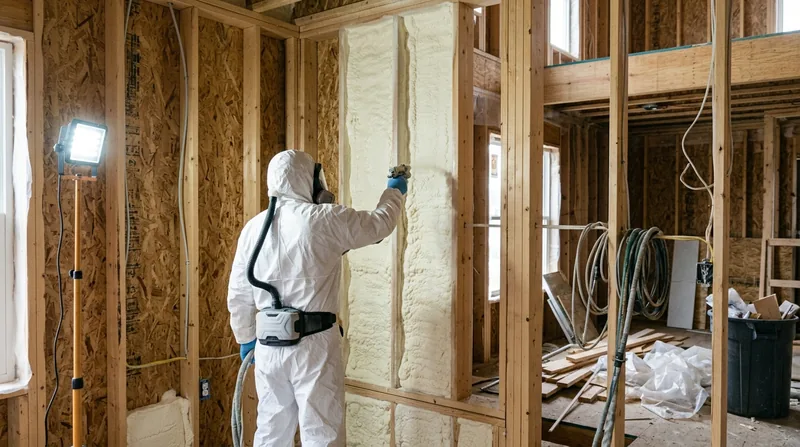




Commercial and new construction spray foam insulation in Des Moines is the fastest way to seal a building envelope before drywall, mechanical rough-in, and final closure. New subdivisions in West Des Moines, Ankeny, Urbandale, Johnston, and Clive are building conventional framed structures with top plates, rim joists, and penetrations that leak stack effect and moisture year-round if left unsealed. Iowa's IECC zone 5A climate, cold winters pulling warm air upward through the ceiling and humid summers pushing moisture back inward, makes air sealing at the framing stage not optional but standard. We spray foam on commercial builds and new residential construction across Polk and Dallas counties, sealing rim joists, top plates, band joists, and all mechanical and electrical penetrations before the drywall crew arrives. The result is a continuous air barrier that holds through the life of the building, stops the stack effect before it starts, and reduces the load on HVAC equipment from day one.
Why Commercial and New Construction Spray Foam Matters in Des Moines
Builder-grade fiberglass and cellulose batts leave gaps at top plates, band joists, and around penetrations. These gaps are invisible once drywall goes up, but they are the source of the stack effect that dominates heating costs in cold climates. Des Moines winters are long and hard, and a rim joist that is not sealed is the first place winter air gets in and conditioned air gets out. On new construction, sealing during framing is the only time you can reach every corner without tearing into finished walls later.
- Spray foam bonds to wood, steel, concrete, and all rim joist and band joist geometry without voids or compression.
- Foam seals penetrations for electrical, plumbing, HVAC, and communication lines before drywall hangs.
- A sealed rim joist stops the cold edge of the basement from radiating into the first-floor rooms above it.
- Continuous foam at the top plate prevents warm air from leaking into attics and crawl spaces during the heating season.
- Closed cell foam on metal stud buildings and barndominiums prevents condensation on the steel and protects the structure from rust.
Getting this right at frame stage is far cheaper than opening walls or attics later to fix air leakage and moisture.
Key info: Des Moines building codes require that spray foam be separated from occupied space by a thermal barrier (drywall, plaster, or intumescent coating). The fifteen-minute thermal barrier standard is set by the International Building Code and enforced by the local building department at your address. Always defer to your building official on what barrier is required for your project.
For more on how foam seals the critical rim joist and band joist areas, see our rim joist and band joist spray foam service page.
For official guidance on commercial building codes in Des Moines, consult the City of Des Moines Community Development and Building Permits office.
How We Approach Commercial and New Construction Spray Foam in Des Moines
On new builds and commercial projects, timing is everything. Our crew works with your general contractor and framing schedule to spray foam at the right window: after framing and air barrier inspection, before drywall and mechanical rough-in. We coordinate with your building official on thermal barrier requirements and ensure that all penetrations are sealed and documented before closure.
- We schedule spray foam during the framing phase, after the building envelope is closed but before interior walls and mechanical systems are installed.
- We seal all rim joists, band joists, top plates, and rim joist-to-foundation transitions with the density and R-value your code requires.
- We seal all electrical, plumbing, HVAC, and communication penetrations to stop air leakage and drafts before drywall hangs.
- We provide written thickness and R-value documentation for every zone so your GC and building official have proof of code compliance.
- We coordinate with your mechanical contractor to ensure that foam does not block ductwork, conduit, or future access to equipment.
- We apply the thermal barrier (drywall or intumescent) or prepare the surface for your drywall crew to apply it immediately after cure.
This sequence keeps your schedule on track and ensures that the air barrier is complete and verified before the building is closed.
Example: A new townhome development in West Des Moines frames 12 units per week. We spray foam the rim joists, top plates, and all penetrations in each unit within 24 hours of framing completion. The developer gets a written estimate with R-value and thickness specs for each unit, documentation for the building official, and zero schedule delays.
For details on how we handle air sealing in concert with foam, visit our air sealing service page.
Commercial and New Construction Spray Foam Methods and Materials
| Approach | Description | Best for |
|---|---|---|
| Closed Cell Spray Foam | High-density foam (3.5 to 3.8 lb/ft³) with an R-value of 6.0 to 6.5 per inch. Moisture and air barrier in one pass. Requires mechanical ventilation during cure and a 24 to 48 hour re-entry window. | Metal buildings, rim joists, band joists, and any application where condensation control or moisture exposure is a concern. |
| Open Cell Spray Foam | Lower-density foam (0.5 to 0.7 lb/ft³) with an R-value of 3.5 to 3.8 per inch. Air barrier only (not a moisture barrier). Faster cure, lower cost per board foot. Requires mechanical ventilation and a 24 hour re-entry window. | Interior walls, top plates, and penetrations in conditioned spaces where moisture exposure is not a concern and cost efficiency is a priority. |
| Injection Foam Retrofit | Low-pressure injection foam (1.5 to 2.0 lb/ft³) injected into existing closed wall cavities without demolition. Used to retrofit pre-1980 homes and commercial buildings with failed or missing insulation. | Retrofit projects on existing buildings where wall cavities are intact and accessible from the outside or inside. |
| Rim and Band Joist Sealing | Closed cell foam applied to the rim joist, band joist, and all foundation transitions. Typical depth is 2 to 4 inches, yielding R-12 to R-26. Sealed against air and moisture. | All new construction and commercial builds in Des Moines, where the rim joist is the first place stack effect and winter infiltration occur. |
Commercial and New Construction Spray Foam Cost in Des Moines: What to Expect
The cost of spray foam on a commercial or new construction project depends on the square footage of rim joist and band joist, the number and size of penetrations, the foam type (closed or open cell), the required thickness and R-value, and the complexity of the geometry. A typical new townhome or single-family home with a full rim joist and standard penetrations runs between $1,500 and $3,500 for closed cell foam. A commercial building or metal structure with a larger footprint and more complex geometry can range from $5,000 to $15,000 or more. The only way to know the exact cost for your project is to get a free commercial estimate with written thickness and R-value specifications.
- Rim joist and band joist sealing is priced per linear foot of foundation perimeter and per inch of foam depth.
- Penetration sealing is priced by the number and size of holes and the time required to seal them completely.
- Metal building and barndominium projects are priced per board foot of closed cell foam applied to the rim, walls, and roof.
- Thermal barrier application (drywall or intumescent coating) is a separate line item and is coordinated with your GC and drywall crew.
We provide a written estimate within 24 hours of your request, with no obligation to book. Call (515) 633-1026 or request a free commercial estimate online. For a detailed pricing overview and typical costs by application, see our full pricing page.
Commercial and New Construction Spray Foam Near Me: What Des Moines Builders Should Know When Hiring
The spray foam trade has three types of operators: local independents with a local address and local plates, out-of-state rig-and-run crews who spray a job in an afternoon and disappear, and national franchises. The difference is accountability, knowledge of local code, and the ability to show up if something goes wrong. When you hire a spray foam contractor for new construction or a commercial project, verify that they carry full insurance, understand your local building code and thermal barrier requirements, coordinate with your GC and building official, and can provide written documentation of R-value and thickness for every zone.
- Ask the contractor to provide proof of current general liability and workers compensation insurance, and verify coverage with their insurance agent.
- Request a written estimate that includes the foam type (closed or open cell), thickness in inches, R-value per zone, and the cost per board foot or per linear foot.
- Confirm that the contractor understands the thermal barrier requirement for your building code and has coordinated with your building official on what barrier is required.
- Check references from recent commercial and new construction projects in Des Moines, West Des Moines, Ankeny, or Urbandale, and ask about schedule adherence and code compliance.
- Verify that the contractor will provide mechanical ventilation during cure and will not allow re-entry until the foam is fully cured (24 to 48 hours for closed cell, 24 hours for open cell).
- Confirm that the contractor will coordinate with your mechanical and electrical trades to ensure that foam does not block conduit, ductwork, or future access to equipment.
The difference between a good spray foam job and a bad one is visible in the estimate itself: a real estimate names the R-value and thickness, specifies the foam type, lists mechanical ventilation and re-entry time, and is signed by someone you can call. A low-ball estimate with no R-value, no thickness, and no re-entry window is the first sign of a rig-and-run operator. Contact us today for a free estimate with full specifications and a local phone number you can reach.
Commercial & New Construction Spray Foam in Des Moines: Pricing Guide
| Service | Price | Details |
|---|---|---|
| Rim joist and band joist sealing | From $1,500 | Typical residential foundation perimeter with closed cell foam, 2-4 inches depth, full documentation included |
| New construction (single-family or townhome) | From $2,000 | Rim joist, top plates, and standard penetrations sealed with closed or open cell foam, written R-value and thickness specs |
| Commercial or metal building | On estimate | Larger footprint, complex geometry, and multiple building zones require site evaluation and custom specifications |
| Thermal barrier application | Separate quote | Drywall or intumescent coating applied after foam cure, coordinated with your GC and drywall contractor |
| Free commercial estimate | No charge | Response within 24 hours, written thickness and R-value specs, no obligation, call (515) 633-1026 |
Indicative pricing, the exact cost depends on square footage, finish, and site access. Free personalized estimate within 24h at (515) 633-1026.


