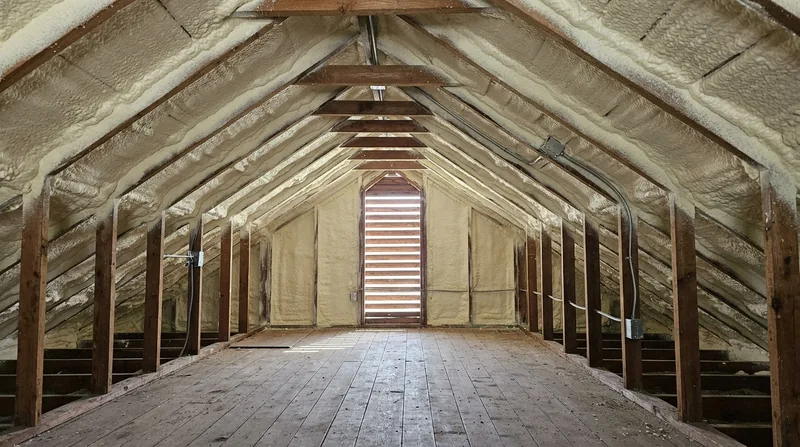




Attic spray foam insulation in Des Moines stops the stack effect that pulls warm air up and out through your ceiling every winter, then keeps upstairs rooms cooler under that same attic during humid Iowa summers. Des Moines sits in IECC climate zone 5A, where hard freezes and moisture-driven heating seasons make the attic deck and roof line the first place energy loss happens. Whether your home is a brick bungalow in Sherman Hill, a postwar ranch across Polk County, or a newer frame house in Ankeny or West Des Moines, stack effect is pulling conditioned air through every gap at the ceiling plane. We spray closed cell or open cell foam across the attic deck or roofline to seal those leaks, control moisture, and hold temperature where you set it. Read on to understand why attic air sealing matters in Des Moines, how the work gets done, and what to expect when you call.
Why Attic Spray Foam Insulation Matters in Des Moines: Stack Effect and Winter Heat Loss
Cold Iowa winters drive stack effect, the physical force that sucks warm air from your living space up through the attic and out through every roof penetration, soffit vent, and gap at the top plate. A vented attic with fiberglass batts or blown insulation cannot stop that flow because air moves around and through loose fill. Spray foam seals the attic deck or roofline completely, breaking the pressure difference that drives the leak. In Des Moines, where heating season runs long and hard, that seal cuts heating load significantly and keeps upstairs bedrooms warm without cranking the thermostat.
- Stack effect pulls warm air up and out through the ceiling in winter, wasting heat and money.
- Fiberglass and blown insulation do not stop air movement, only slow it down.
- Spray foam seals the attic deck or roofline, stopping the leak at the source.
- Sealed attics also control humidity in summer, keeping upstairs rooms cooler without oversizing the AC.
Once the attic is sealed with spray foam, the pressure balance shifts and the heating system works for you instead of against you.
Key info: Beaverdale's brick homes from the 1920s-40s and Sherman Hill's Victorian houses carry original vented attics with gaps at the plate line and around penetrations. A single attic spray foam retrofit stops that leak for the life of the roof. New subdivisions in West Des Moines, Ankeny, and Johnston are building conventional framed attics with builder-grade insulation that still leaves air leakage at the top plate, making spray foam the upgrade that matters most.
For more on how spray foam compares to other insulation methods, see our guide to open cell spray foam insulation, which offers a lighter touch at a lower cost for attics where moisture control is less critical.
How We Install Attic Spray Foam Insulation in Des Moines: The Process
Spray foam attic work starts with a walk-through to measure the space, identify penetrations and obstacles, and confirm the existing insulation condition. We establish mechanical ventilation to manage vapors during application, then spray the foam in controlled passes to the specified thickness and density. Once cured, the foam is hard and dimensionally stable, and the space is re-entered after the manufacturer's re-entry window, typically 24 to 48 hours. The entire process is measured and documented with R-value and thickness specs on your final invoice.
- We measure the attic, identify all roof penetrations, and plan the spray pattern before any foam is applied.
- Mechanical ventilation is set up and running before the first pass to control odor and vapors during cure.
- Foam is sprayed in controlled layers to the thickness and density specified in your estimate, with the ratio and drum temperature verified on each pass.
- Once cured, the attic is documented with R-value and thickness specs, and you receive a written record of the work.
- Re-entry is permitted after the manufacturer's cure window, typically 24 to 48 hours in Des Moines summer conditions.
The result is a sealed, insulated attic that stops heat loss in winter and controls temperature swings in summer without the air movement that comes with loose fill.
Example: A 1,500 square foot ranch in Clive with a vented attic and fiberglass batts loses 15 to 20 percent of its heating energy through the ceiling. We spray 5.5 inches of closed cell foam across the deck, seal the soffit vents, and air-seal the rim joist from the basement. The homeowner reports upstairs rooms warm in January and no condensation on windows, with heating bills down noticeably by March. See our air sealing service for details on how rim joist and band joist sealing works alongside attic foam.
Attic Spray Foam Methods: Closed Cell vs. Open Cell
| Approach | Description | Best for |
|---|---|---|
| Closed Cell Spray Foam | Dense, rigid foam with R-value of 6.0 to 6.5 per inch. Vapor barrier and air seal in one pass. Highest cost per square foot. | Sealed roof decks, attics with moisture risk, spaces where condensation control is critical in Iowa's humid climate. |
| Open Cell Spray Foam | Lighter, softer foam with R-value of 3.5 per inch. Air seal without vapor barrier. Lower cost per square foot, easier to add to later. | Vented attics, sound dampening, attics where budget is the priority and moisture risk is low. |
| Closed Cell on Roofline Only | Spray 2 to 3 inches of closed cell on the underside of the roof sheathing, then blow open cell or fiberglass over the floor for R-value. | Sealed attics in older homes where the floor is hard to access or where a hybrid approach reduces cost. |
| Top-Up Over Existing Insulation | Spray foam directly over sound, dry fiberglass or cellulose to add R-value and seal air leaks without removal. | Attics with adequate existing insulation but poor air sealing or settling in blown-in material. |
The choice between closed cell and open cell depends on your attic condition, your moisture profile, and your budget. We recommend closed cell for sealed attics and high-risk areas, and open cell or blown-in top-up for vented attics where air sealing is the priority. For details on the closed cell option, see closed cell spray foam insulation.
Attic Spray Foam Insulation Cost in Des Moines: What to Expect
Attic spray foam insulation in Des Moines typically runs from $1.50 to $3.00 per square foot for closed cell foam, and $0.75 to $1.50 per square foot for open cell, depending on the thickness, density, and whether existing insulation is being removed or covered. A 1,500 square foot attic sprayed with 5.5 inches of closed cell foam costs between $2,250 and $4,500 before any removal work. Open cell at 6 to 8 inches runs $1,125 to $2,250 for the same space. The final cost depends on attic access, the condition and type of existing insulation, roof penetrations, and whether the job includes rim joist or band joist sealing from the basement.
Several factors move the price up or down. A tight attic with poor access costs more per square foot because the work is slower and riskier. Existing insulation that is wet, contaminated, or heavily settled must be removed before foam is applied, adding labor and disposal cost. Roof penetrations, skylights, and plumbing vents require extra sealing and care. Rim joist sealing from the basement is a separate line item that typically costs $8 to $15 per linear foot and adds $500 to $2,000 to the job depending on the length of the rim.
The best practice is to get written estimates from two or three contractors with R-value and thickness specs on each quote, so you can compare apples to apples. Estimates should include what is being removed, what is being sprayed, and the re-entry timeline. Visit our pricing page for a detailed breakdown of what moves the cost for your specific attic.
Attic Spray Foam Insulation Near Me: What Des Moines Homeowners Should Know When Hiring
Hiring a spray foam contractor in Des Moines means checking three things: insurance, estimates, and references. The spray foam trade has rig-and-run crews that spray in an afternoon and are unreachable when the smell will not go away, and it also has national franchises with high overhead and generic estimates. The local independent with a local address and local plates is the position to verify. Ask any contractor for proof of current liability and property damage insurance, and call the insurance company to confirm the policy is active and the coverage is adequate for spray foam work. Get written estimates from at least two contractors with R-value and thickness specs, not just a price per square foot. Call references and ask about the smell during cure, the re-entry timeline, and whether the contractor was reachable after the job was done.
- Verify current liability insurance by calling the carrier directly, never trust a certificate alone.
- Get written estimates with R-value per inch and total thickness specified, not just a board-foot price.
- Ask references about odor during cure, the actual re-entry window, and contractor availability after the job.
- Check whether the contractor has done work in your neighborhood or building type, and ask for photos or site visits if available.
- Confirm that mechanical ventilation will be running during the spray and cure, and that a re-entry window of 24 to 48 hours is stated in writing.
Des Moines and surrounding areas like West Des Moines, Ankeny, and Urbandale have building departments that govern attic ventilation and thermal barrier requirements. Some jurisdictions require permits for attic insulation work, and some do not. Call your local building department or ask your contractor to confirm what applies at your address before work starts. Homeowners associations in master-planned subdivisions may have architectural rules that govern exterior work on metal buildings or additions, but attic insulation is typically interior and falls outside HOA review. When in doubt, ask your HOA or your contractor to check.
Ready to get started? Contact us for a free estimate with no obligation. We will measure your attic, review the existing insulation, and provide a written quote with R-value and thickness specs within 24 hours. Call (515) 633-1026 to schedule.
Attic Spray Foam Insulation in Des Moines: Pricing Guide
| Service | Price | Details |
|---|---|---|
| Open Cell Spray Foam Attic | Starting at $0.75/sq ft | Lighter density foam, 6 to 8 inches, for vented attics where air sealing is the priority and cost matters |
| Closed Cell Spray Foam Attic | Starting at $1.50/sq ft | Dense rigid foam, 5.5 inches, for sealed attics and moisture control in Des Moines humid climate |
| Attic Insulation Removal and Replacement | Starting at $0.50/sq ft removal | Cost to haul out old fiberglass, cellulose, or failed foam before new spray foam is applied to bare deck |
| Rim Joist or Band Joist Sealing | Starting at $8/linear ft | Spray foam seal on basement rim joist, typically $500 to $2,000 depending on house perimeter and access |
| Estimate and Site Visit | Free | Measure, assess existing insulation, and provide written quote with R-value and thickness specs within 24 hours |
| Travel within Des Moines Service Area | Included | No mileage fee or travel charge for Des Moines, West Des Moines, Ankeny, Urbandale, Johnston, Clive, and surrounding areas |
Indicative pricing, the exact cost depends on square footage, finish, and site access. Free personalized estimate within 24h at (515) 633-1026.


