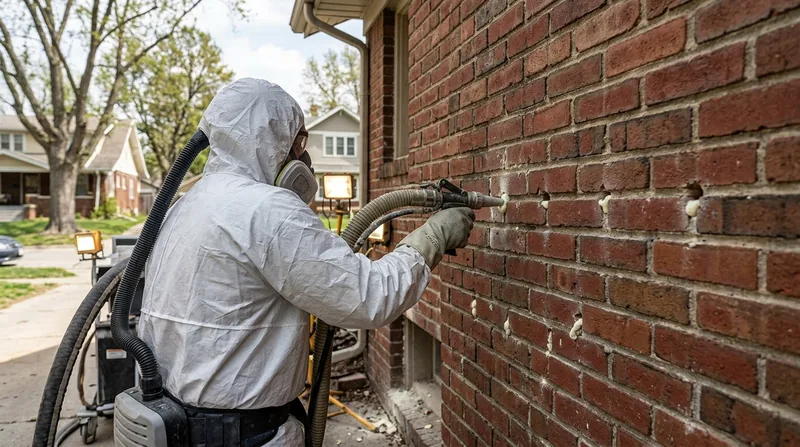




Wall & Injection Foam Insulation in Des Moines solves a problem that hits Des Moines homes hard every winter: empty wall cavities that bleed heat straight out through the exterior. Brick homes in Beaverdale built in the 1920s and 1930s, frame construction near Drake and Sherman Hill, and countless early-1900s bungalows across Highland Park all carry hollow walls that were never properly insulated when they were built. Iowa's climate zone 5A means cold, hard winters and humid summers that push moisture and conditioned air through those gaps relentlessly. We drill small holes and inject foam into the existing wall cavity, sealing air leaks and closing gaps without removing plaster or siding. The result is warmer rooms, lower heating bills, and a dry wall assembly that stops the stack effect from pulling warmth straight up and out of your home.
Why Wall & Injection Foam Insulation Matters in Des Moines Homes
Des Moines sits in a climate where the heating season is long and cold, and the stack effect (warm air rising and escaping through the top of the house) is the single biggest driver of energy loss. Wall cavities that are empty or filled with loose, settled insulation become thermal highways for that escape. Older homes in Beaverdale, Sherman Hill, and around Drake have walls that were built before modern building codes required cavity insulation, leaving you heating the neighborhood instead of your living room. Even postwar ranches and split-levels across Polk County often have gaps at top plates, around windows, and in corners where the original builder cut corners or where insulation has shifted over fifty years.
- Empty cavities in brick and frame walls lose heat continuously during the heating season, driving up January and February utility bills.
- Injection foam fills voids without demolition, preserving original plaster, siding, and the character of older homes.
- Closed-cell foam in walls creates an air barrier that stops infiltration and controls moisture movement in humid summer months.
- The process takes hours, not days, with minimal disruption to your home or yard.
Once the foam cures, your walls stop acting as a draft and your heating system stops working overtime.
Key info: Beaverdale's brick homes and Sherman Hill's Victorian frame construction are prime candidates for injection foam because the cavities are accessible from inside, and the exterior can remain completely untouched. No siding removal, no scaffolding, no exterior mess.
For more detail on how we approach air sealing as part of a complete insulation strategy, see our air sealing service page. You can also check the Des Moines city building department website for any specific code requirements on wall insulation in your neighborhood.
How We Inject Foam Into Walls: The Process in Des Moines
The injection foam process is straightforward and causes minimal disruption. We locate the wall cavity, drill small holes (typically 1 to 1.5 inches in diameter) at strategic intervals, insert the injection gun, and fill the cavity with closed-cell foam. The foam expands slightly, seals all the voids, and cures to a solid state. We then patch the holes with matching material, and the wall looks untouched. The entire process on a typical wall takes four to eight hours, depending on the size and complexity of the cavity.
- We locate the cavity using moisture meters and thermal imaging to confirm the wall is dry and suitable for foam.
- We drill access holes at measured intervals, typically 16 to 24 inches apart vertically and horizontally.
- We inject closed-cell foam at the correct ratio and temperature, filling from the bottom of the cavity upward to prevent voids.
- We allow the foam to cure for 24 to 48 hours before patching and painting the holes.
- We verify thickness and density with a probe to confirm the cavity is fully sealed.
Your wall is now a complete air barrier with an R-value of approximately 6 to 7 per inch, depending on foam type and cavity depth.
Example: A homeowner in West Des Moines with a 1950s ranch and cold exterior walls in the master bedroom had the cavities injected with closed-cell foam. The bedroom temperature rose 4 to 6 degrees within a week, and the heating system no longer cycled as hard during cold snaps. The holes were patched and painted, and the exterior siding remained completely undisturbed.
For homes with severely damaged or contaminated insulation, you may need insulation removal before injection foam can be installed safely.
Wall & Injection Foam Methods and Applications
| Method | Description | Best For |
|---|---|---|
| Closed-Cell Injection Foam | High-density foam injected into cavities, expands slightly, creates air barrier and moisture control layer. | Exterior walls in cold climates, basements, rim joists, and any cavity where moisture control is critical. |
| Open-Cell Injection Foam | Lower-density foam, softer after cure, excellent sound dampening, allows vapor transmission. | Interior walls, partition walls, and sound-sensitive applications where vapor permeability is acceptable. |
| Cavity Fill (Retrofit) | Injection into existing empty cavities without demolition, preserves original materials and finishes. | Historic homes in Beaverdale and Sherman Hill, brick construction, and any wall where exterior access is limited. |
| Top-Up or Partial Fill | Injecting foam into cavities that already contain settled or degraded insulation, topping up to full density. | Homes with old fiberglass batts or loose-fill that have shifted, where complete removal is not necessary. |
Wall & Injection Foam Insulation Cost in Des Moines: What to Expect
Wall injection foam insulation in Des Moines typically starts at $2 to $4 per square foot, depending on cavity size, wall height, foam type, and accessibility. A typical exterior wall in a 1,500-square-foot home might run $800 to $1,500 to inject completely. Factors that move the price up include deep cavities (taller walls), difficult access (interior walls in finished spaces), and the need to remove old insulation before foam can be injected. A free written estimate with R-value and thickness specifications is the only honest way to know what your job will cost, because every home is different.
- Wall size and linear feet of cavity determine material and labor time more than any other single factor.
- Cavity depth (how far the wall extends) affects the amount of foam needed and the number of access holes required.
- Existing insulation that must be removed before foam can be injected adds time and cost.
- Interior access versus exterior access changes the drilling strategy and the patching requirements.
Always get 2 to 3 estimates before booking, and make sure each one specifies R-value, thickness, and the number of access holes. For a detailed pricing breakdown and to schedule your free estimate, visit our pricing page or call us at (515) 633-1026.
Wall & Injection Foam Insulation Near Me: What Des Moines Homeowners Should Know Before Hiring
Hiring a spray foam contractor for wall injection work requires the same diligence as any other home improvement. The first step is to verify that any contractor you call carries full insurance and can provide proof of coverage. Ask for references from recent jobs in Des Moines or nearby suburbs like West Des Moines, Ankeny, or Urbandale, and call at least two to confirm the work quality and the contractor's responsiveness after the job. Permits for wall insulation are rare in Des Moines unless the work involves structural modifications, but always check with your local building department or HOA before starting, especially in master-planned communities where exterior drilling or patching may require approval.
- Verify full insurance coverage and ask for a certificate of insurance; never work with a contractor who cannot provide one.
- Request a written estimate that includes R-value per inch, thickness, number of access holes, and patching method.
- Check references from homeowners in your neighborhood or similar-era homes in Des Moines.
- Confirm that the contractor will conduct a moisture assessment before injecting foam into any wall cavity.
- Ask about the re-entry window (typically 24 to 48 hours) and mechanical ventilation during cure, especially if you have young children or pets.
Red flags include estimates with no R-value or thickness specified, promises of immediate re-entry after spraying, prices far below market, and insurance that cannot be verified. The right contractor will explain what the foam does, why your wall needs it, and what to expect during and after the job. For a consultation with a local spray foam insulation contractor, contact us today or call (515) 633-1026 for a free estimate.
Wall & Injection Foam Insulation in Des Moines: Pricing Guide
| Service | Price | Details |
|---|---|---|
| Wall Cavity Injection (Closed-Cell) | Starting at $2/sq ft | Complete cavity fill with closed-cell foam, includes drilling, injection, curing, and patch repair on interior surface. |
| Partial Cavity Fill or Top-Up | Starting at $1.50/sq ft | Topping up existing settled insulation with new foam, fewer access holes required, lower material and labor cost than full cavity. |
| Multi-Story or Complex Wall | On estimate | Tall walls, interior access constraints, or removal of old insulation first require site assessment before pricing is set. |
| Travel and Setup | Included | No mileage or travel fees within Des Moines and surrounding service area communities, included in estimate and final invoice. |
| Free Written Estimate | No obligation | Includes R-value, thickness, access hole count, and patching method, response within 24 hours at (515) 633-1026. |
Indicative pricing, the exact cost depends on square footage, finish, and site access. Free personalized estimate within 24h at (515) 633-1026.


