Why Sherman Hill Victorians Have Unique Insulation Challenges
Sherman Hill's Victorian and early 20th-century homes are architectural treasures, but their age brings significant insulation challenges that modern houses don't face. These historic properties were built with solid brick walls, plaster interiors, and attic spaces that were never designed with modern energy efficiency in mind. The irregular wall cavities, settling foundations, and original construction methods make retrofitting insulation far more complex than in newer homes.
If you own a Sherman Hill Victorian in Des Moines, you're likely dealing with either no insulation at all or deteriorated materials that have lost their R-value over decades. Traditional blown-in insulation and fiberglass batts can struggle in these spaces because they don't conform to irregular cavities, don't seal air leaks, and can settle unevenly over time. This is where modern insulation solutions make a real difference for preserving both your home's character and your comfort.
Spray Foam vs Blown In Insulation: Which Works Better for Historic Homes
When comparing spray foam vs blown in insulation for Sherman Hill Victorians, the differences become immediately apparent. Blown-in insulation (typically cellulose or fiberglass) is pumped into wall cavities and attic spaces as loose material. While it's less expensive upfront and easier to install in accessible areas, blown-in insulation has significant limitations in historic homes. It doesn't seal air leaks, it can shift and settle over time leaving gaps, and it struggles to fill irregular cavities created by settling foundations and original construction methods.
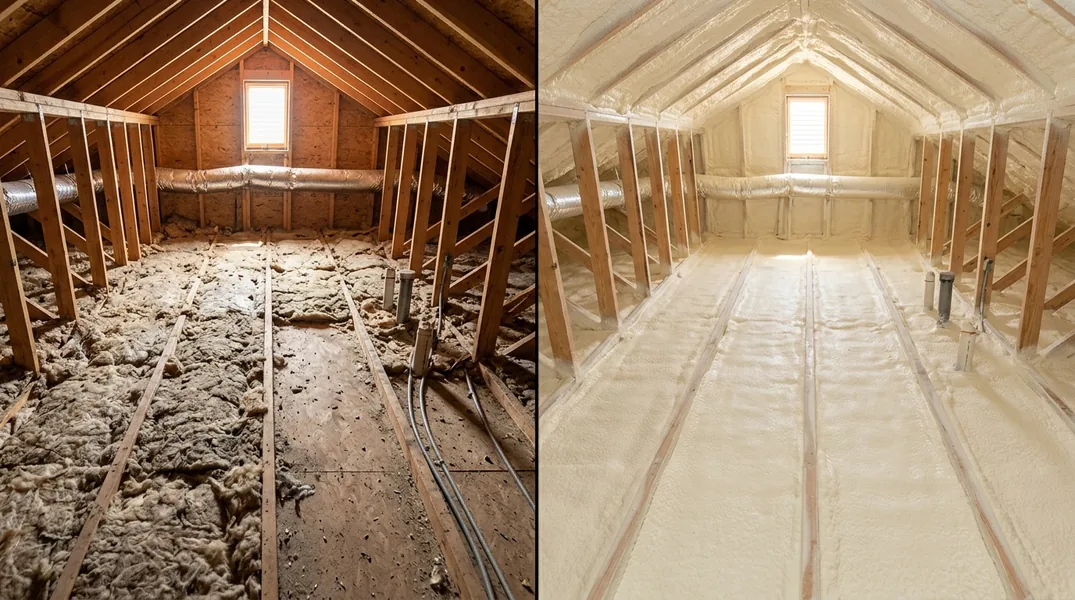
Attic Spray Foam Insulation expands as it's applied, conforming perfectly to every nook, cranny, and irregular space in your walls and attic. This expansion creates an air-tight seal that blown-in materials simply cannot match. For Victorian homes with uneven wall cavities, original plaster, and decades of settling, spray foam's ability to fill every gap means superior thermal performance and moisture control. The difference in energy efficiency can be 20 to 30 percent better with spray foam, which translates to meaningful savings on heating and cooling costs year-round.
Spray Foam vs Fiberglass: Performance Comparison for Attic Insulation
Fiberglass batts have been the standard insulation choice for decades, and they remain common in many homes. However, spray foam vs fiberglass reveals why spray foam is increasingly the preferred choice for attic spaces in older homes. Fiberglass batts work reasonably well when installed in uniform cavities with proper spacing, but they're only effective if installed perfectly. Any gaps, compression, or moisture exposure reduces their R-value significantly. In Sherman Hill Victorians, where attic spaces are often irregular and subject to moisture issues, fiberglass batts frequently underperform.
Closed Cell Spray Foam Insulation provides superior R-value per inch (typically R-6 to R-7 per inch versus R-3.2 for fiberglass), creates a complete air seal, and offers vapor barrier protection in one application. This is particularly important in Des Moines where winter humidity and temperature swings can cause moisture problems in attic spaces. Closed-cell foam prevents warm, moist interior air from reaching cold attic surfaces where it would condense. For historic homes prone to moisture issues, this protection is invaluable.
Spray Foam vs Cellulose: Why Spray Foam Wins for Wall Cavities
Cellulose insulation, made from recycled paper, is often marketed as an eco-friendly blown-in option. When comparing spray foam vs cellulose, both materials have environmental benefits, but cellulose has performance limitations in historic wall applications. Cellulose is treated with fire retardants and can absorb moisture, which is problematic in older walls that may already have moisture concerns. It also settles over time, potentially leaving voids at the top of wall cavities where heat loss is greatest. In Sherman Hill's climate with significant seasonal temperature changes, this settling can reduce effectiveness considerably.
Wall & Injection Foam Insulation using closed-cell or open-cell spray foam provides permanent, stable insulation that won't settle or shift. The foam expands to fill every cavity completely and bonds to surrounding materials, creating structural reinforcement that actually strengthens walls. For Victorian homes with original brick walls or plaster, this added rigidity can be beneficial. Additionally, spray foam's superior air-sealing properties reduce drafts and temperature stratification that plague homes insulated with cellulose or fiberglass.
Open Cell vs Closed Cell Spray Foam: Choosing the Right Type for Your Historic Home
Understanding the difference between open-cell and closed-cell spray foam is essential for Sherman Hill homeowners. Open Cell Spray Foam Insulation is lighter, less expensive, and slightly more flexible. It provides good insulation (R-3.5 to R-3.8 per inch) and excellent sound dampening. However, open-cell foam is not a vapor barrier and allows moisture to pass through, which can be problematic in attic spaces or exterior walls. Closed-cell foam, by contrast, is denser, provides superior R-value, and acts as a vapor barrier. It's more expensive but offers better protection against moisture infiltration and air leakage.
For Sherman Hill Victorians, closed-cell spray foam is typically the better choice for attics and exterior walls because these spaces are most vulnerable to moisture and air infiltration. However, interior wall cavities or basement rim joists might benefit from the cost savings and sound control of open-cell foam. The best choice depends on your specific application, your home's condition, and your budget. A professional evaluation can help determine which type will deliver the best performance for your historic property. Contact Des Moines Spray Foam Insulation at (515) 633-1026 to discuss your specific needs and get a free estimate.
Attic Spray Foam Insulation Cost in Des Moines: What to Budget
Understanding pricing for attic spray foam insulation helps Sherman Hill homeowners make informed decisions. Spray foam typically costs more per square foot than blown-in insulation or fiberglass, ranging from $1.50 to $3.50 per board foot depending on foam type, thickness, and application complexity. For a typical attic space, you might invest $3,000 to $8,000 or more. However, this higher upfront cost delivers substantial long-term value through energy savings, improved comfort, and protection against moisture damage that could cost thousands to repair.
The actual cost depends on several factors specific to your historic home. Older attics often have more irregular framing, obstructions, and accessibility challenges that increase labor time. The R-value you need also affects total cost, as higher R-values require thicker foam applications. Most importantly, the energy savings from superior insulation performance typically offset the higher initial investment within 5 to 10 years, and the protection against moisture damage and thermal loss continues indefinitely. For a detailed quote tailored to your Sherman Hill Victorian, reach out to Des Moines Spray Foam Insulation at (515) 633-1026 or request a free estimate online.
Looking for a professional spray foam insulation contractor in Des Moines? Des Moines Spray Foam Insulation responds fast for all your spray foam insulation needs.
Get a Free Quote